Jetway & Aircraft Ground Power Reliability Starts with Voltage Control
Transformers and Line Drop Compensators for 400Hz Systems Airport gates are a high-pressure environment. Jetways (jet bridges), gate power cabinets,...
Control Transformer designs high-performance, fully customized magnetic solutions that are tailored to your power, frequency, and environmental needs.
Control Transformer has more than 70 years of experience delivering reliable, custom-engineered magnetic solutions across numerous industries.
4 min read
By: Control Transformer, Inc. on Jan 27, 2026 1:44:07 PM
Airport gates are a high-pressure environment. Jetways (jet bridges), gate power cabinets, and aircraft ground power connections have to work consistently—often across long cable runs, shifting loads, and harsh outdoor conditions. When power quality isn’t stable, the consequences can be immediate: equipment faults, delayed turnarounds, or aircraft systems rejecting the power feed.
For many aviation ground power applications, the most common technical challenge is also one of the least glamorous: voltage drop.
Most aircraft ground power systems use 400Hz AC (often delivered as 115/200V, 3-phase) because it enables lighter electrical equipment onboard the aircraft. The tradeoff is that distributing 400Hz power through cables creates more voltage drop than the same cable carrying 60Hz power. If left uncorrected, voltage at the aircraft receptacle can fall below acceptable limits and the aircraft may reject the power source.
This is one reason aviation ground power specifications and product literature consistently emphasize voltage regulation, compensation, and performance compliance.
In practice, voltage drop risk increases with:
When people think “aircraft ground power,” they often picture the power converter itself (fixed or mobile GPU), but the supporting electrical infrastructure matters just as much. Transformers are commonly used across these systems to:
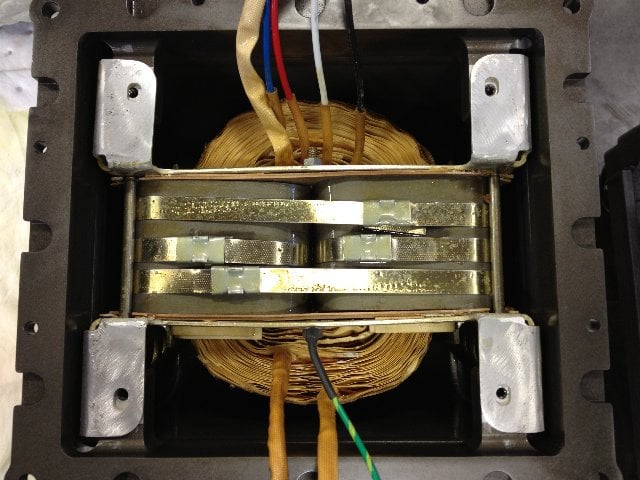
In aviation ground power applications, transformers are not simply commodity components. They must be engineered with a clear understanding of frequency, duty cycle, load variability, and system layout. Poorly matched or under-designed transformers can exacerbate voltage drop issues rather than mitigate them.
In aviation power discussions, the term “line drop compensation” is often used to describe strategies for addressing voltage loss over extended cable runs. In some systems, this function is handled by dedicated equipment; in others, it is addressed through overall electrical system design.
From a transformer perspective, line drop compensation is best understood as a design objective, not necessarily a standalone product. Transformer selection, winding configuration, impedance characteristics, and voltage regulation all influence how well a system maintains acceptable voltage at the point of use.
For aviation ground power systems, this means transformer solutions must be designed to:
By addressing voltage drop at the design level, system reliability improves and the likelihood of operational disruptions decreases.
Airports are dynamic facilities. As terminals expand, gates are reconfigured, or centralized power systems are upgraded, cable distances can increase over time. Long cable runs are often unavoidable, particularly in large hubs or facilities designed to support wide-body aircraft.
Increasing conductor size or adding parallel cable runs can help reduce voltage loss, but these approaches add cost, complexity, and installation challenges. As a result, aviation electrical systems often rely on carefully engineered transformer solutions to help manage voltage behavior without excessive infrastructure changes.
This approach supports scalability and future-proofing, allowing airport operators and ground support equipment OEMs to adapt systems as operational needs evolve.
Across aviation ground power and jetway-related applications, engineers and procurement teams tend to focus on a consistent set of performance criteria when evaluating transformer solutions:
Transformers designed specifically for aviation applications help ensure that voltage control strategies perform as intended, even in demanding operational conditions.
Control Transformer has extensive experience designing custom transformer solutions for aviation applications, including ground power and gate infrastructure environments. Rather than offering one-size-fits-all products, Control Transformer focuses on application-engineered solutions that support reliable power delivery in real-world conditions.
By working closely with customers to understand voltage requirements, frequency considerations, cable distances, and load behavior, Control Transformer helps ensure that transformer designs support effective voltage management throughout the system.
This design-driven approach aligns with the broader electrical ecosystem found in aviation ground power systems, where transformers, converters, distribution equipment, and controls must work together seamlessly.
Voltage management in jetway and ground power applications is one part of a larger aviation power landscape. Transformers used throughout aviation environments—whether supporting ground equipment, terminal infrastructure, or specialized systems—must meet elevated performance and reliability expectations.
For readers interested in a broader discussion of transformer performance in aviation settings, Control Transformer explores this topic in more depth in a related article:
High-Performance Transformers for Aviation Applications
https://www.control-transformer.com/news-insights/high-performance-transformers-for-aviation-applications
Together, these articles provide complementary perspectives: one focused on system-level voltage challenges at the gate, and the other on transformer performance across aviation environments.
As aircraft systems continue to advance and airport operations demand faster turnaround times, the importance of reliable ground power will only increase. Voltage drop, long cable runs, and variable loads are not temporary challenges—they are structural realities of aviation infrastructure.
Addressing these challenges starts with transformer solutions that are engineered for the application, not adapted as an afterthought. By accounting for voltage behavior, frequency effects, and system layout early in the design process, aviation power systems can deliver consistent, dependable performance where it matters most.
Control Transformer partners with aviation OEMs, infrastructure teams, and system integrators to develop transformer solutions that support safe, efficient, and reliable ground power delivery—helping keep operations moving smoothly at the gate.
Talk with Our Aviation Power Experts
Control Transformer designs custom transformer solutions for aviation ground power and gate infrastructure applications. If you’re evaluating voltage requirements, 400Hz systems, or long-run power challenges, our team can help engineer a solution that fits your application.
Transformers and Line Drop Compensators for 400Hz Systems Airport gates are a high-pressure environment. Jetways (jet bridges), gate power cabinets,...
Transformers are among the most critical — and expensive — assets in any electrical system. They’re expected to operate reliably for decades, but...
Transformers, though often out of sight and out of mind, are workhorses in electrical systems. Their lifespan isn’t just a matter of design — how you...
Tell us about your magnetics needs. We'll give you an estimate of the resources needed to engineer a product to meet your exact specs, complete with a preliminary design.